Ramooz e Auqaf are punctuation marks used in Urdu writing. These marks help readers understand sentences clearly and correctly. Without punctuation, writing may look confusing and difficult to read.
In Urdu grammar, Ramooz e Auqaf show pauses, emotions, questions, and sentence endings. Students, teachers, writers, and Urdu learners all use these marks in daily writing.
Learning Ramooz e Auqaf improves Urdu grammar, writing style, and reading skills. It also helps students perform better in exams and assignments.
You May Like: fiber door design
What is Ramooz e Auqaf?
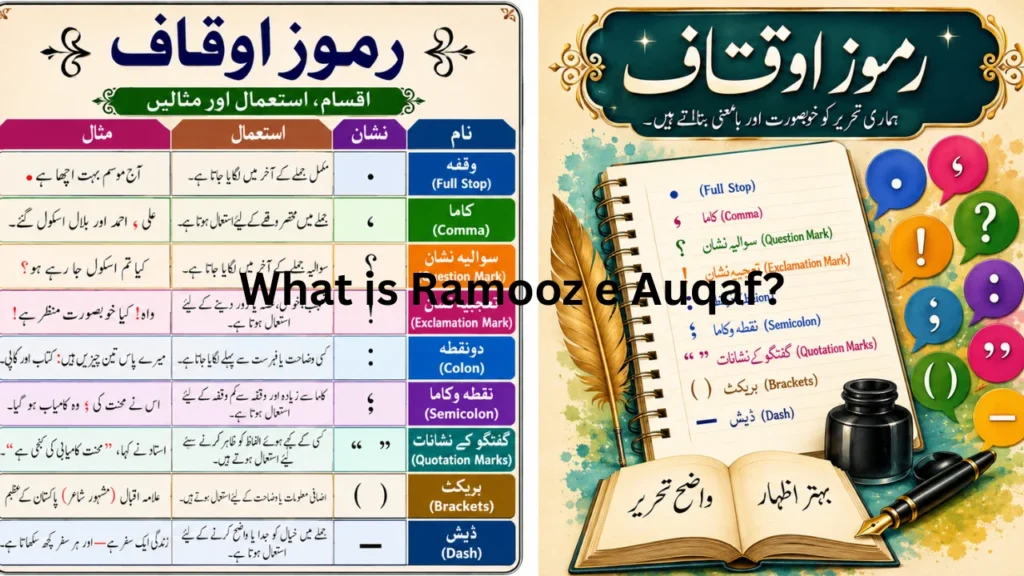
The word Ramooz e Auqaf means punctuation symbols used in Urdu language. These symbols guide the reader about how to read a sentence.
Just like English punctuation marks, Urdu punctuation marks also improve sentence structure and meaning.
Example
- Ahmed school gaya۔
- Kya tum theek ho؟
- Wah! Kitna pyara manzar hai۔
Each punctuation mark changes the tone and meaning of the sentence.
Importance of Ramooz e Auqaf in Urdu Grammar
Ramooz e Auqaf are very important in Urdu grammar and writing. They make sentences clear, smooth, and easy to understand.
Improve Sentence Clarity
Punctuation helps readers understand where a sentence starts and ends.
Create Proper Pauses
These marks tell readers where to stop or pause while reading.
Improve Writing Skills
Correct punctuation makes essays, stories, and letters look professional.
Help Students in Exams
Students can score better marks by using punctuation correctly.
Make Reading Easier
Well-punctuated content is easier to read and understand.
Main Types of Ramooz e Auqaf
There are several types of punctuation marks in Urdu. Each mark has a specific purpose.
Full Stop (۔)
The full stop is used at the end of a complete sentence.
Example
- Ali bazar gaya۔
- Aaj mausam acha hai۔
Purpose of Full Stop
It shows that the sentence has ended.
Comma (،)
Comma is used for a short pause in a sentence.
Example
- Ahmed, Ali, aur Bilal school gaye۔
- Agar tum mehnat karo, tum kamyab ho jaoge۔
Purpose of Comma
It separates words and ideas clearly.
Question Mark (؟)
Question mark is used after asking a question.
Example
- Tumhara naam kya hai؟
- Kya tum school ja rahe ho؟
Purpose of Question Mark
It tells the reader that the sentence is asking something.
Exclamation Mark (!)
Exclamation mark shows emotion or surprise.
Example
- Wah! Bohat khoob۔
- Oh! Yeh kya hua؟
Purpose of Exclamation Mark
It expresses strong feelings like happiness or shock.
Colon (:)
Colon is used before a list or explanation.
Example
- Mere pas teen cheezen hain: kitab, qalam, aur copy۔
Purpose of Colon
It introduces information or details.
Semicolon (؛)
Semicolon creates a pause stronger than a comma.
Example
- Ali ne mehnat ki؛ woh kamyab ho gaya۔
Purpose of Semicolon
It connects related sentences.
Quotation Marks (“ ”)
Quotation marks show someone’s exact words.
Example
- Teacher ne kaha, “Mehnat kamyabi ki kunji hai۔”
Purpose of Quotation Marks
They are used in dialogues and direct speech.
Brackets ( )
Brackets provide extra information.
Example
- Allama Iqbal (Mashhoor shayar) Pakistan ke azeem mufakkir thay۔
Purpose of Brackets
They add additional details in a sentence.
Dash (—)
Dash separates ideas or adds emphasis.
Example
- Zindagi aik safar hai—aur har safar kuch sikhata hai۔
Purpose of Dash
It highlights important information.
Ramooz e Auqaf in Urdu Writing
Ramooz e Auqaf improve the quality of Urdu writing. Without punctuation, readers may misunderstand sentences.
Correct punctuation helps in:
- Essay writing
- Story writing
- Letter writing
- Academic work
- Online content writing
Good punctuation also improves the flow of reading.
Ramooz e Auqaf Examples in Daily Life
People use punctuation marks every day in different forms of communication.
In School Work
Students use punctuation in homework and exams.
In Social Media Posts
People use punctuation while posting messages online.
In Newspapers
News articles use punctuation for clarity.
In Books and Stories
Writers use punctuation to improve storytelling.
Common Mistakes in Ramooz e Auqaf
Many students make punctuation mistakes in Urdu writing.
Missing Full Stops
Wrong Example
- Ahmed school gaya
Correct Example
- Ahmed school gaya۔
Incorrect Use of Commas
Wrong Example
- Ali, school gaya, aur, usne, homework kiya۔
Correct Example
- Ali school gaya aur usne homework kiya۔
Wrong Question Marks
Wrong Example
- Tum kaha ja rahe ho۔
Correct Example
- Tum kaha ja rahe ho؟
Ramooz e Auqaf for Students
Students should practice punctuation daily because it is an important part of Urdu grammar.
Benefits for Students
- Better exam preparation
- Improved grammar
- Clear handwriting work
- Better essay writing
- Strong reading skills
Teachers often include punctuation questions in exams.
Ramooz e Auqaf in Creative Writing
Creative writing becomes more interesting with proper punctuation marks.
Example
- “Ruko!” usne zor se kaha۔
- “Kya tum sach keh rahe ho؟” Ahmed ne poocha۔
These marks help readers understand emotions and dialogue clearly.
Difference Between Urdu and English Punctuation
Urdu and English punctuation marks are similar, but Urdu follows right-to-left writing style.
| Urdu Symbol | English Symbol | Usage |
|---|---|---|
| ۔ | . | Full Stop |
| ؟ | ? | Question Mark |
| ، | , | Comma |
Both languages use punctuation to improve readability.
Easy Tips to Learn Ramooz e Auqaf
Learning punctuation becomes easier with regular practice.
Read Urdu Books Daily
Books help students see correct punctuation examples.
Practice Short Paragraphs
Writing daily improves punctuation skills.
Learn One Rule at a Time
Focus on one punctuation mark before learning the next.
Revise Grammar Regularly
Revision helps students remember punctuation rules.
Ramooz e Auqaf in Urdu Literature
Urdu literature uses punctuation marks to create beauty and emotion.
Poets, story writers, and novelists use punctuation to improve expression and flow.
Without proper punctuation, literary writing may lose meaning and impact.
Why Ramooz e Auqaf Are Important Today
Today, people write emails, blog posts, messages, and online articles every day. Proper punctuation makes digital writing clear and professional.
Good punctuation also improves readability for website visitors and readers.
That is why content writers and bloggers focus on Ramooz e Auqaf while writing Urdu content.
Frequently Asked Question
What are Ramooz e Auqaf in Urdu?
Ramooz e Auqaf are punctuation marks used in Urdu writing. They help readers understand pauses, questions, emotions, and sentence endings clearly.
Why are Ramooz e Auqaf important?
Ramooz e Auqaf improve sentence clarity and make writing easier to read. They also help students write better essays and grammar exercises.
How many types of Ramooz e Auqaf are there?
There are many types of Ramooz e Auqaf, including full stop, comma, question mark, exclamation mark, colon, semicolon, quotation marks, brackets, and dash.
What is the use of a full stop in Urdu?
A full stop (۔) is used at the end of a complete sentence. It shows that the sentence has finished.
Where is the question mark used in Urdu?
The question mark (؟) is used after interrogative sentences or questions.
What is the purpose of a comma in Urdu writing?
A comma (،) creates a short pause and separates words, phrases, or ideas in a sentence.
How do Ramooz e Auqaf improve Urdu grammar?
Ramooz e Auqaf make sentence structure clearer and help readers understand the correct meaning of the text.
Are Ramooz e Auqaf included in Urdu exams?
Yes, Ramooz e Auqaf are an important part of Urdu grammar and are often included in school and board exams.
What are common mistakes students make in Ramooz e Auqaf?
Students often forget full stops, use commas incorrectly, or place question marks in the wrong sentences.
How can students learn Ramooz e Auqaf easily?
Students can learn Ramooz e Auqaf by reading Urdu books, practicing writing daily, and revising grammar rules regularly.
Conclusion
Ramooz e Auqaf are an important part of Urdu grammar and communication. They make writing clear, meaningful, and easy to read. From full stops to question marks, every punctuation mark plays a special role in sentence structure.
Students, writers, and Urdu learners should practice Ramooz e Auqaf regularly to improve their Urdu writing skills. Proper punctuation not only improves grammar but also helps readers understand ideas easily.
People Also Read: takmeel e hayat novel
